Ultrasound Skin Tightening Machines: What Focused Ultrasound Buys You
An ultrasound skin tightening machine is a professional aesthetic platform that sends focused ultrasound energy to a set depth under the skin to heat tissue and trigger collagen remodeling. The label covers a wide spread of hardware, from handheld home gadgets to clinic-grade systems with interchangeable cartridges and multiple handles. This page is for clinic owners and distributors comparing those professional platforms, not for someone shopping for a home device.
Our focused ultrasound platform
What Counts as an Ultrasound Skin Tightening Machine
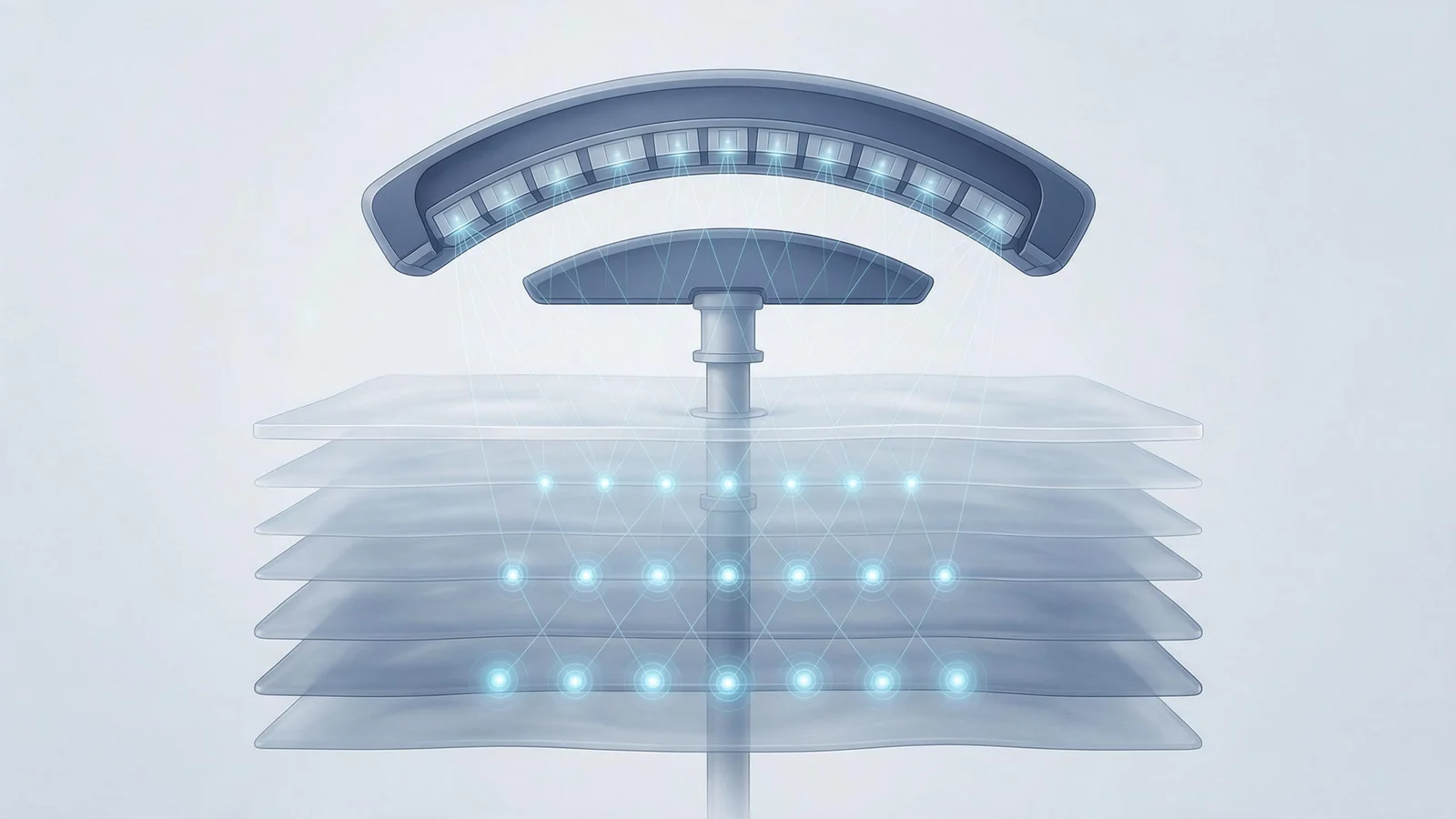
Aesthetic focused ultrasound is not physiotherapy ultrasound and it isn't diagnostic or medical HIFU either. The physiotherapy units you'll see in a rehab clinic run at 1 MHz or 3 MHz through a flat 7 cm2 transducer and they're used for thermal therapy over a broad area, not for a precise focal point below the dermis. Medical HIFU for tumor ablation is a different animal again. The aesthetic version delivers focused energy to a set depth to heat tissue and trigger collagen remodeling, and the depth is chosen by the cartridge, not by how long you hold the handpiece in one spot.
If you want the mechanism explained properly, we keep that on our HIFU technology page rather than repeating the physics here. What matters for a buyer is that the term HIFU gets used loosely online for everything from a clinic platform with three handles to a handheld gadget sold for home use. This page is about the professional platforms sold to clinics and distributors. The ones that come with replaceable cartridges, defined focal depths, and a service relationship behind them.
One more boundary. Non-ablative skin resurfacing and focused ultrasound are sometimes lumped together in marketing copy, but they are different modalities with different tissue targets. Our engineering archive's guide to skin problems treats non-ablative skin resurfacing as its own section for exactly that reason.
Specification Lines That Actually Differ Between Machines
When you compare two ultrasound face lift machines, most of the spec sheet is noise. Four lines do the real work: cartridge depths per handle, output frequency range, output power range, and how many handles the platform carries. Cartridge depths decide what you can treat. Frequency range and power range tell you how the energy is delivered. Handle count tells you how many treatment categories you can sell from one box. A fifth line, consumable logic, decides whether the machine makes money after month three.
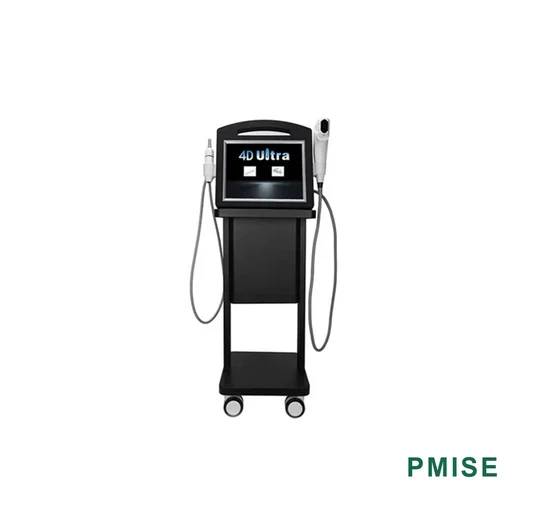
Take the HF-01 as a concrete example. It ships with a 4D handle, a V-max handle, and an optional vaginal handle. The 4D handle takes 3.0 mm and 4.5 mm cartridges as standard, with 16 mm, 13 mm, 10 mm, 8 mm, and 6 mm optional. The V-max handle takes 1.5 mm, 3.0 mm, and 4.5 mm as standard, with 8 mm and 13 mm optional. The vaginal handle takes 3.0 mm and 4.5 mm. Output frequency is 4-7 MHz, output voltage is 10-200W, and it runs from a 10 inch touch screen on an AC110/220V±10%, 50Hz-60Hz supply.
Here's the same information as a table you can copy into a tender document or a distributor deck.
| Specification line | HF-01 |
|---|---|
| Model name | Pmise HF-01 |
| Treatment handles | 4D Handle, V-max Handle, Vaginal Handle (Optional) |
| 4D Handle cartridge depths | 3.0mm, 4.5mm (Optional: 16mm, 13mm, 10mm, 8mm, 6mm) |
| V-max Handle cartridge depths | 1.5mm, 3.0mm, 4.5mm (Optional: 8mm, 13mm) |
| Vaginal Handle cartridge depths | 3.0mm, 4.5mm |
| Output frequency | 4-7MHz |
| Output voltage | 10-200W |
| Screen | 10 inch touch screen |
| Package dimension | 20*40*54cm³ |
| Gross weight | 11kg (base not included) |
| Power supply | AC110/220V±10%, 50Hz-60Hz |
Notice what isn't in that table. We don't publish a line count per shot, energy per line, or any parameter that isn't in the model table. If a supplier quotes you those numbers, ask them for the source document that backs it. If they can't produce one, treat the number as marketing.
On the clinical side, the industry reference is that microfocused ultrasound with visualization uses transducers of different frequencies to heat tissue at depths of 1.5, 3.0, and 4.5 mm, targeting the mid-dermal tissue. That's the depth logic behind cartridge selection, and it's the reason a platform with only one or two depths constrains your treatment menu. A histological study on pig skin treated with HIFU at specific depths of 2.0, 3.0, 4.5, and 6.0 mm assessed collagen types I and III, elastin fibers, and fat reduction using immunohistochemistry, Victoria blue staining, and Oil Red O staining. If you're evaluating depth options, that's the kind of evidence to ask a supplier to point you toward for their own device, because it doesn't transfer automatically from one platform to another.
Matching the Platform to Your Client Mix
There is no single best ultrasound face lift machine, and anyone who tells you otherwise is selling something. The right configuration depends on the clients who actually walk through your door.
If your demand is face-only, you need a handle that covers dermal and subdermal face depths and you can stop there. The 4D handle with 3.0 mm and 4.5 mm cartridges covers that lane. If your demand is face plus neck plus body, you'll want the optional deeper and shallower cartridges on the same handle, because neck work and body work sit at different depths from the cheek and jaw. A clinic that also wants a vaginal handle is buying a third treatment category, and that means the optional Vaginal Handle with its 3.0 mm and 4.5 mm cartridges, plus the training and consent process that comes with an intimate treatment.
Map it like this: face-only practices run one handle and two cartridges. Face, neck and body practices run two handles and a broader cartridge set. Practices adding an intimate treatment line run all three handles and budget for the extra training and room time. The platform doesn't change between those three. The configuration does.
Keep outcome language honest. You can tell a client that focused ultrasound is used for tightening, lifting and wrinkle reduction in aesthetic practice. Don't promise a lift percentage, a fixed number of sessions, or a durability window, because those numbers aren't yours to promise and they vary by patient, depth, and technique.
Consumable Logic and Cost Per Treatment
This is where a lot of clinic owners get surprised. The handles are reusable. The cartridges are the per-patient consumable. Every time you fire a cartridge you're spending against its rated life, and when it's done it's done. So your cost per session isn't the machine price divided by sessions, it's cartridge consumption plus room time plus operator time.
That means the configuration you buy should be driven by cartridge life and the treatment categories you actually sell, not by the sticker on the platform. A clinic doing fifteen face treatments a week burns cartridges at a very different rate from one doing three. Ask for cartridge life figures in writing, ask what the replacement terms are, and ask whether the cartridge is locked to a single handpiece or interchangeable across handles.
We quote per configuration, and we don't publish prices. No price, price range, or cost figure for our equipment appears on this page or anywhere on our site, because the configuration you need determines the quote. If you're comparing suppliers, the question to ask each one is the same: what's the rated life of this cartridge, what does replacement cost in your market, and what's the lead time on resupply. For a deeper look at how cartridge economics play out across platforms, our guide on HIFU cartridge economics walks through the math.
Safety, Screening and Treatment Boundaries
A trained operator is not optional. Focused ultrasound is an energy device, and the operating environment needs to be controlled the same way you'd control a laser room.
On screening, the reference material is clear that pregnancy and breastfeeding are standard exclusion boundaries for aesthetic energy treatments, and autoimmune conditions need individual assessment before you book. Patients with metal implants need a specific conversation: continuous and pulsed ultrasound are not contraindicated over metal implants, though application requires precautions to avoid standing waves, and MRI facilities apply a standardized screening policy for anyone with suspected foreign metallic implants regardless of field strength or magnet type. That's a screening question, not a treatment decision. Refer out when the history is unclear.
Skin type matters too. Post-inflammatory hyperpigmentation risk is higher in darker Fitzpatrick types, and it's a real conversation to have before treatment, not after. This is educational material for equipment buyers, not medical advice. Diagnosis and treatment decisions belong with a qualified clinician.
Questions to Put to Any Ultrasound Platform Supplier
None of the pages ranking for this topic tell clinics what documentation to demand. Here's the checklist. Copy it.
- Regulatory clearance for the exact model. Ask for the FDA 510(k) number, CE certificate, TGA listing, or Health Canada licence that names the specific model you're buying. A generic certificate for the brand is not enough. For reference, in the US this device type is regulated under 21 CFR 878.4590, 'Focused Ultrasound Stimulator System for Aesthetic Use', as a Class II device, and a clearance is issued as a 510(k) decision letter naming the specific device. That's the standard of documentation to ask for, whichever supplier you're talking to.
- Device spec sheets in writing, covering cartridge depths, frequency range, and power range for the exact configuration quoted.
- Cartridge life and replacement terms, including rated shots or hours and resupply lead time in your market.
- Training offered, and whether it's on-site, remote, or a train-the-trainer model for distributors.
- Shipping and Incoterms, because a 11 kg gross weight unit and a 20*40*54 cm³ package ship very differently from a palletized system.
- Warranty and defect-handling policy in writing before you order, including who pays return freight and how long a replacement takes.
- Spare-parts terms, so you're not stuck when a handle needs service three years in.
If a supplier can't answer those seven in writing, that's your answer.
How We Quote the HF-01
Pmise is a Beijing-based manufacturer of laser, light and energy-based aesthetic equipment. We sell professional platforms to clinics and distributors, and we quote per configuration. For HF-01, configuration means which handles you take and which cartridge depths you select on each one.
We don't publish prices, certifications, clearance numbers, client names, or case studies. Not because we're hiding anything, but because those aren't ours to publish as marketing claims. If you need documentation, request it directly and we'll tell you exactly what exists and what doesn't. That's a better starting point for a distributor relationship than a glossy PDF with numbers nobody can trace.
If you're weighing focused ultrasound against radiofrequency or microneedling for your client mix, our guide on focused ultrasound machine types breaks down where each modality fits, and the HF-01 product page carries the full model table.
FAQ
Does ultrasonic skin tightening really work?
Focused ultrasound is an established aesthetic modality with published histological evidence behind it. A 2023 study in the journal Cells reported that high-intensity focused ultrasound increases collagen and elastin fiber synthesis by modulating caveolin-1 in aging skin. That's a mechanism finding, not a guarantee for any individual patient or device. Results vary by depth, technique, and skin condition, and no supplier should promise you a specific outcome. Judge any platform on its configuration and documentation, not on a claim.
Can ultrasound be used to tighten skin?
Yes, in the aesthetic focused-ultrasound sense. Aesthetic platforms deliver focused energy to a set depth to heat tissue and trigger collagen remodeling, and the industry reference is that microfocused ultrasound with visualization uses transducers of different frequencies to heat tissue at depths of 1.5, 3.0, and 4.5 mm, targeting the mid-dermal tissue. This is different from physiotherapy ultrasound, which uses a broad 1 MHz or 3 MHz field for thermal therapy, and different again from medical HIFU used for ablation.
How long does ultrasound skin tightening last?
We can't give you a durability figure, and neither should any supplier who hasn't treated your specific patient. Duration depends on the depth treated, the patient's age and skin condition, and their maintenance routine. What we can tell you is that collagen remodeling is a biological process, not a one-time event, so the clinical conversation is about a treatment plan rather than a single session. Ask any supplier to show you the published evidence behind their duration claims.
What specifications should a clinic compare between ultrasound skin tightening machines?
Four lines do the real work: cartridge depths per handle, output frequency range, output power range, and handle count. A fifth, consumable logic, decides your cost per session. For example, the HF-01 has a 4D handle with 3.0 mm and 4.5 mm cartridges standard and six optional depths, a V-max handle with 1.5 mm, 3.0 mm and 4.5 mm standard, and an optional vaginal handle, with output frequency 4-7MHz and output voltage 10-200W.
Evidence and further reading
Educational material for equipment buyers and operators. It is not medical advice, an operating protocol or a promise of clinical outcome.
- Microfocused ultrasound with visualization: Consensus ... - PMC
- Do Different High-Intensity-Focused Ultrasound Frequencies Have Different Effects? A Histological Analysis Correlated With Patients' Subjective Assessments
- FDA 510(k) decision letter K180623: focused ultrasound stimulator system for aesthetic use (21 CFR 878.4590)
- High-Intensity Focused Ultrasound Increases Collagen and Elastin Fiber Synthesis by Modulating Caveolin-1 in Aging Skin
- ELECTROPHYSICAL AGENTS - Contraindications And Precautions
- Magnetic Resonance Imaging (MRI) Safety and Biological Effects - StatPearls - NCBI Bookshelf
Ready to spec your next machine?
Tell us the indication, your market and the certifications you need. Our export team replies with a configuration and quotation within 12 to 24 hours.