[email protected]  ·  +86 133 2121 6666 FDA / CE / RoHS / SGS certified
Pmise CF-01 Ultrapulse CO2 Fractional Laser, 10600nm
CO2 Fractional Laser

Pmise CF-01

Ultrapulse CO2 fractional laser at 10600nm. Built for scar revision and resurfacing in clinics that already know how to handle downtime.

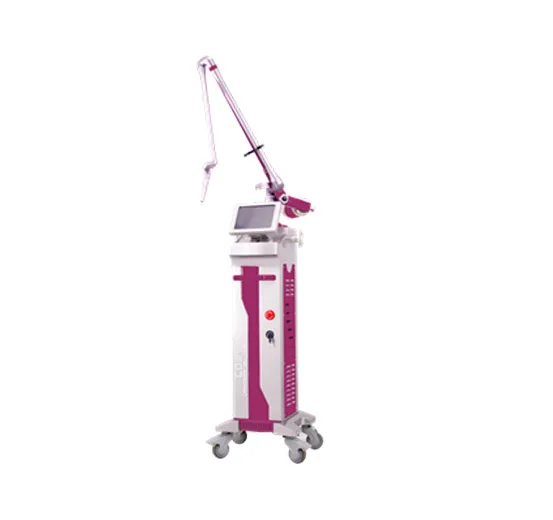
CF-01 is an RF-excited CO2 laser at 10600nm running continuous, ultrapulse and fractional modes from one console. It's the CO2 fractional laser machine clinics buy when scar revision needs its own consent form, not a slot on the facial menu.

Pulse energy spans 2 to 200mJ in 2mJ steps. Densities run 6x6 to 24x24 spots per cm², through a 7-joint arm with six scan shapes, because faces aren't rectangles.

Who buys it: dermatology clinics, plastic surgery units and medspas with a physician on site. Not a salon shopping for no downtime. Pigment and tattoo work needs a different pulse regime, handled by our QE-01 Q-switched Nd:YAG platform.

How it works

At 10600nm the chromophore is water, and skin is mostly water. The beam is absorbed within the first tens of micrometres and vaporises tissue where it lands. Fractional mode splits that energy into a grid of microscopic columns and leaves bridges of untreated skin between them. That's why fractional wounds close in days, not weeks. Manstein and colleagues described the principle in 2004; the wavelength logic sits in our note on selective photothermolysis.

Here's the trade-off nobody spells out at a trade show. Energy per microbeam sets column depth. Density sets how much surface you ablate. Shah and Alam split it plainly: deeper zones from higher fluence suit acne scarring and tightening, shallower and denser coverage suits fine photodamage and dyspigmentation. Push both up and you're running full-field ablation with extra steps, recovery bill included. Our manuals put the focused spot near 0.25mm and maximum penetration at up to 2mm. Coverage proportion shrinks the treated area while density holds: 1x1cm at 6x6 set to 1/2 treats 0.5x0.5cm, still 6x6. Deep and sparse for boxcar scarring. Shallower and denser for texture.

Fire adjacent columns back to back and heat stacks. Scatter them and each cools first. Our manuals are blunt: never scan an area more than three times, never overlap graphics. Remodelling runs for months, so judging a scar at week two is a mistake. How far you push is a patient question, and our note on reading Fitzpatrick skin types says where to stop.

Applications

  • Atrophic acne scarring, boxcar and rolling, where sparse deep columns beat a dense shallow pass
  • Surgical and traumatic scars; our archive notes older, soft, pliable scars respond best
  • Fractional and full-field resurfacing for coarse texture, enlarged pores and fine lines
  • Photodamage and actinic change under physician supervision, once a biopsy question is settled
  • Benign epidermal lesion ablation in CW and ultrapulse modes, an experienced-operator job

Key advantages

  • RF-excited COHERENT source: our archive puts RF tube life in tens of thousands of hours against hundreds for glass tubes
  • 2 to 200mJ in 2mJ steps plus four densities, a real protocol ladder, not three presets
  • Coverage proportion decouples treated area from density, so you can go gentle without losing depth
  • Sequential or randomized scanning to spread thermal load across the field
  • Air cooling only. No water loop to service, no cartridges to reorder

Specification

Laser TypeCOHERENT RF-excited CO2 laser
Wavelength10600nm
Laser Power30W / 25W / 20W (optional)
Operating ModeCW, UP, CPG
Pulse Width0.067-0.67ms
Spot Diameter50-2000μm
Scanning ModeSequential / randomized
Pulse Energy2-200mJ
Pulse Interval1-100ms (step 1ms)
Spot GraphicTriangle / square / rectangle / rhombus / round / line
Beam Delivery7-joint arm
Spot Density6x6, 12x12, 18x18, 24x24 spots/cm²
Scan Area1x1, 2x2, 3x3cm
CoolingAir cooling
Net Weight60kg

Frequently asked questions

Can darker skin types be treated?

Cautiously, and plenty of clinics decline ablative CO2 for Fitzpatrick V and VI outright. Published guidance points at density first: keep it low in skin of colour. Prophylaxis beats clever settings. Photoprotection either side, a low-energy test spot on a hidden site, whatever pigment-suppressing topical the clinician prescribes. One small 2008 series in types IV and V saw no hyperpigmentation.

How much downtime, and how far apart should sessions sit?

Density and energy decide that, not the machine. Published reviews put fractional CO2 recovery near seven to ten days of crusting and swelling, erythema longer. Light passes land at the short end. Heavy scar work doesn't. Space deep sessions months apart, not weeks, and send stalled healing back to a clinician.

What are the consumables and the running cost?

None in the disposable sense. No cartridges, no per-shot tips, no gas bottles, no chiller loop. Running cost is electricity, periodic optics cleaning and calibration, eyewear, a smoke evacuator and aftercare products. The device carries Class 4 labelling, so budget for room control too.

What training and support come with it?

CO2 is the most operator-dependent platform we sell. Every CF-01 ships with a full English manual, and our team runs remote clinical training on parameters, pass technique and aftercare. We won't ship to a buyer who can't name a trained operator. Servicing belongs to authorised technicians.

What do I get, how long does it take, and what's covered?

Warranty is one year on material and workmanship defects; scanner, foot switch, articulated arm and freight sit outside it, and paid service runs for the machine's life. In the crate: arm and transmission system, scanner handpiece, foot switch, power cord, keys, patient eye-shields, operator goggles, spare fuses, manual. You refit arm and scanner on arrival, guided by our engineers. Optics and spares come through us or your agent. Lead time and destination paperwork are confirmed in writing with the quotation. Ask for a quote or a remote demo.

What can this machine not do?

It isn't a pigment or tattoo laser; melanin and ink want nanosecond pulses, which is QE-01 territory. It won't lift real laxity or fix active acne, and it isn't for keloid-prone skin, active infection, vitiligo, immunosuppression or recently irradiated tissue. Screening is the clinician's job.

Evidence and further reading

Educational material for equipment buyers and operators. It is not medical advice, an operating protocol or a promise of clinical outcome.

Ready to spec your next machine?

Tell us the indication, your market and the certifications you need. Our export team replies with a configuration and quotation within 12 to 24 hours.