[email protected]  ·  +86 133 2121 6666 FDA / CE / RoHS / SGS certified
Pmise CR-01 Cryolipolysis Fat Freezing
Body Contouring

Pmise CR-01

A cryolipolysis fat freezing machine built on four vacuum applicators, two of them running at once. Cold does the work, and the body clears the treated fat over the weeks that follow.

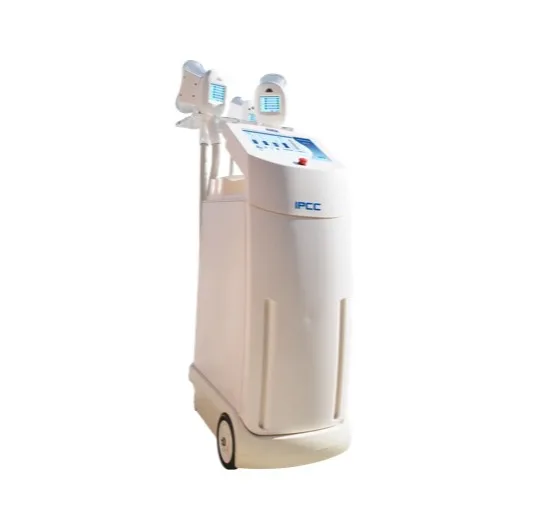
CR-01 is a cryolipolysis fat freezing machine for pinchable, localized fat. The applicator draws the fold into a cooled cup and holds it in a controlled low-temperature window, with an infrared assist pre-conditioning tissue before cooling starts. Four handles ship in two window sizes, and our device manuals map them plainly. The two large cups, 165x81mm, are meant for the broad planes of buttock and abdomen. The small pair takes partial areas where a large window would never seal properly against the fold.

Who buys it? Clinics adding a first body service, and busy contouring rooms that want a treatment which doesn't tie up an operator for the full hour. The console lets you select two handles at once, so one bed covers flank and flank, or abdomen and thigh, per cycle. Once the cups are placed, the machine holds the protocol itself. No optical cabinet. No eyewear. No grounding pads.

It earns its place as the low-overhead body machine on a mixed floor. Weighing it against light and energy platforms first? Our technology notes on skin typing and energy selection cover that ground.

How it works

Fat cells are more vulnerable to cold than skin, nerves or muscle. That single asymmetry is the whole treatment. It traces back to Manstein and Anderson's 2008 paper on selective cryolysis, which reported that prolonged, controlled surface cooling selectively damaged subcutaneous fat without harming the skin above it. CR-01 works in a band of -5 to 14°C, and our manual's starting protocol sits at 1 to 4°C for 30 minutes. Selection follows from that, not from the console. Pinch the area yourself before you quote: a soft fold that lifts cleanly is the case that works, while a firm abdomen that won't tent is fat behind the muscle wall, and cold cannot reach it.

Vacuum matters as much as the cold. Drawing the fold into the cup lifts the target layer clear of deeper structures and holds it against cooling plates on both faces. Suction, infrared, temperature and time are set per handle, so two zones can run different protocols on the same client. Our manual is blunt about one setting: suction frequency stays at I throughout.

Clearance is biological, so nothing happens fast. Over the following weeks the affected adipocytes leave through normal metabolic pathways and the treated layer thins. Book the review photo at week eight, not week two. Promise next-week change and you buy refunds. Recovery in between is dull for most people, and dull is the goal. Redness, some swelling, a bruise at the cup margin and a numb patch over the treated pad are the ordinary aftermath, not signs of trouble. Late-onset soreness in the second week is the one that generates the phone call. Staff that call, brief the operator, and say all of it before the cup goes on. A warned client waits out the fortnight. An unwarned client books a complaint.

Prep is unglamorous, and it's where operator mistakes live. Cleanse, apply petroleum jelly, place the antifreeze membrane, seat the cup. Skip the membrane and you risk a cold injury. Cooling is semiconductor, backed by water and air: roughly 1800ml of distilled water at commissioning, changed about every 30 days in regular use, with the room held between 10 and 30°C.

Applications

  • Pinchable, localized fat on the abdomen, flanks, back rolls, thighs and upper arms, in weight-stable clients who can grip the bulge between finger and thumb
  • Submental and jawline fullness with the small handle, once a clinician confirms the fullness is fat
  • Post-pregnancy shape work on the lower abdomen and flanks, after healing and with a doctor's clearance
  • Contour refinement after liposuction, planned with the operating surgeon rather than around them
  • Course selling with the RF-01 skin tightening platform when the real complaint is laxity as much as volume
  • A first body service for a facial-only clinic. No optical shielding, short training

Key advantages

  • Four handles in two window sizes, the larger at 165x81mm, two selectable at once
  • Temperature, vacuum, infrared and time set per handle, so two zones can run different protocols
  • Setting the temperature to 15°C parks the cooling system, a standby operators actually use
  • On-screen water circulation warning when flow drops, which is the fault that kills handles
  • Consumables stop at membranes and gel. No lamp, tip or cartridge with a shot counter
  • Short training. The real skill is candidate selection and consent, not driving the console

Specification

Negative Pressure-0.02 to -0.19MPa
Working Time1-90min (step 1min)
IR Power6-12W
Temperature-5 to 14°C
Suction FrequencyI-IV (step I)
Window Size165x81mm (LP-LI); 128x27mm (LP-SI)
Power1300W
Screen12.1 inch TFT touch screen
Power SupplyAC 220V 50Hz; AC 110V 60Hz
Net Weight55kg

Frequently asked questions

Does skin type change who you can treat?

Cryolipolysis doesn't chase a chromophore, so Fitzpatrick type matters far less here than on a light-based device. Pigment isn't the risk; tissue condition is. Know the limits too. This isn't weight loss, it does nothing for visceral fat behind the abdominal wall, and it won't tighten loose skin. If there's nothing to pinch, decline the sale. Weight-stable clients with a discrete bulge are the ones who come back happy.

Who should not be treated?

Anyone with a cold-related disorder. The cryolipolysis patient-selection literature names cold urticaria, cryoglobulinaemia and paroxysmal cold haemoglobinuria or cold agglutinin disease as conditions that rule it out. Reviews add Raynaud phenomenon, hernias and scarring over the target as relative contraindications. If a lump doesn't feel like fat, stop and refer for diagnosis. That judgement belongs to a clinician, not to whoever is holding the handle.

What do I warn the client about, and what belongs on the consent form?

Separate two things. Common and transient: erythema, oedema, bruising at the cup margin, numbness or paraesthesia over the treated pad, and delayed-onset pain in the first two weeks. The adverse-event review by Deligonul and colleagues reports these as the usual complaints, appearing early and settling without intervention. Rare and different in kind: paradoxical adipose hyperplasia, where the treated pad enlarges into a firm bulge weeks or months later. Published incidence estimates vary widely, reported cases haven't resolved on their own, and correction has been surgical. Put that one in writing.

How do I plan sessions and throughput?

Two handles run at once and our manual's starting protocol is 30 minutes, so one bed clears two zones per cycle. Budget ten minutes either side for cleansing, membrane placement and massage, putting a client at roughly 40 to 50 minutes door to door. Plan one to three sessions per zone. That's six to eight clients a day on one machine, not twenty. Price the course on that number, not on the cycle time.

What does it cost to run, and what support ships with it?

Membranes, petroleum jelly and distilled water. Budget one membrane per applicator placement and treat that as fixed, never as a saving. No lamp or cartridge with a shot count, so cost per session stays flat as volume climbs. Training runs about a day. Manual, interface guide and spare handles ship with the machine; warranty terms are set per order.

Evidence and further reading

Educational material for equipment buyers and operators. It is not medical advice, an operating protocol or a promise of clinical outcome.

Ready to spec your next machine?

Tell us the indication, your market and the certifications you need. Our export team replies with a configuration and quotation within 12 to 24 hours.