HIFU Explained: How Focused Ultrasound Reaches the SMAS
HIFU is high intensity focused ultrasound, and the easiest way to picture it is a magnifying glass burning a leaf in sunlight: the energy itself isn't special, the focusing is. This page is the technology note for clinic owners and distributors who want the physics before the brochure, so we'll walk from the transducer geometry down to the thermal coagulation point and the cartridge depths you'll be quoting. The numbers you'll see for depth and frequency come from our own spec tables and the public sources listed at the bottom.

What High Intensity Focused Ultrasound Actually Is
HIFU stands for high intensity focused ultrasound, and the definition matters more than the acronym. ICNIRP describes ultrasound as oscillating mechanical energy above 20 kHz, which is past the top of the audible range for most people, and diagnostic scanners run between 1 MHz and 40 MHz. Focused ultrasound takes that same energy and does something different with it: instead of spreading it across a beam, it converges it on a small volume inside the tissue. Same physics. Very different intent.
The clinical world has used that principle for years. IEC 60601-2-62:2013 is the particular safety standard for high intensity therapeutic ultrasound equipment, and the standard also covers equipment for treating occluding feeding vessels and for relieving cancer pain from bone metastases. So when a patient asks whether HIFU is a real medical modality, the honest answer is yes, it's regulated therapeutic ultrasound. The aesthetic version is narrower. It uses the same focusing to create controlled heat in collagen-rich layers for lifting and tightening, and the FDA's focused ultrasound category for aesthetic use sits under 21 CFR 878.4590, the regulation named in the Ulthera K180623 and Classys K230100 clearances.
Our platform, the Pmise HF-01, operates at an output frequency of 4-7MHz and an output voltage of 10-200W, with a 10 inch touch screen. Those are the only output figures we publish for the machine, and they are worth holding onto because frequency and depth are not the same variable, a point most brochures blur.
How a Curved Transducer Concentrates Energy Into a Focal Zone
A transducer is the part that converts electrical drive into acoustic energy, and in HIFU it isn't flat. It's curved, so each point on the emitting surface sends its wave inward toward a common geometric focus. Picture a satellite dish, except it's pushing sound instead of pulling signal. The waves arrive at the focus at the same time and add up. Away from the focus, they don't, so the energy density falls off quickly.
This is why the skin surface is spared. The focal point sits below the surface, at a distance set by the curvature of the transducer and the cartridge design. The tissue between the surface and the focus sees the energy at low intensity on the way in and on the way out. Only the small focal volume gets enough to matter. That's the whole trick, and it's also why a HIFU treatment feels different from a surface heating device: the heat is being made where you can't see it.
Don't confuse this with a diffuse beam. A diffuse beam heats a broad area and relies on bulk cooling to protect the surface. A focused beam makes a small, predictable lesion at a known depth. Predictability is the product. It's also why cartridge alignment and coupling matter so much in practice, and why we won't quote a focal accuracy figure we haven't measured.
Thermal Coagulation Points and What They Do to Tissue
A thermal coagulation point is a discrete lesion created at the focus, a small volume of tissue raised to a temperature where protein denatures. The clinical literature on microfocused ultrasound with visualization describes these as discrete thermal coagulation points, or TCPs, generated at precise depths in the dermis and subdermal tissue. The review notes therapeutic temperatures around 60°C, which is above the threshold for collagen denaturation and well below the point where you'd worry about bulk necrosis if the energy were spread out.
Here's the part that separates a trained operator from a button-presser. The lesions are placed as spaced dots and lines. Not painted continuously. Pulses are delivered along a line with a defined interval, and the untreated tissue between them is what allows the skin to heal without a continuous wound. If you overlap too densely, you're not treating more aggressively, you're just making a bigger injury with a worse recovery profile.
The change that follows is biological, not mechanical. Coagulated collagen contracts, then the wound-healing response remodels the area over weeks. That's why a patient who looks in the mirror the next morning and sees nothing hasn't been cheated. The Araco (2020) prospective study of 50 subjects described in the same review treated the SMAS, subcutaneous tissue and deep dermis at 4.5, 3.0 and 1.5 mm in a single session, with doctors scoring ptosis improvement over 80 points out of 100, as reported in the Microfocused Ultrasound With Visualization narrative review. That's a physician-scored endpoint, not a photograph, and the timeline is measured in months.
Focal Depth Is Fixed Per Cartridge: Dermis vs SMAS
Each cartridge has a fixed focal depth. You cannot tune it mid-treatment. This is a geometric property of the transducer inside the cartridge, not a software setting, and it catches out buyers who assume depth is a dial. If you want to reach a different layer, you change the cartridge and start again.
What happens if you treat at the wrong depth? Nothing dramatic in the moment, which is exactly the problem. Energy delivered to a layer that doesn't need it is either wasted or, at depth, deposited near structures you'd rather leave alone. Depth carries risk, and the deeper cartridges carry more of it.
The mapping is straightforward. 1.5 mm targets the dermis. 3.0 mm reaches deeper dermis and subcutaneous tissue. 4.5 mm is the one aimed at the SMAS, the superficial musculoaponeurotic system, and it's the depth that does the lifting work and the depth that demands the most respect. Deeper is not automatically better. A 4.5 mm cartridge on a thin face is not a superior treatment, it's a different risk decision, and the honest position is that the operator's judgement about tissue thickness matters more than the cartridge list. If you want the layer-by-layer version with the anatomy drawn out, our guide to HIFU focus depths goes further than this page should.
Cartridge Depths and Frequency on the Pmise HF-01
The HF-01 ships with three treatment handles, and the cartridges are where the clinical capability lives. Here's the list exactly as our spec table records it.
| Handle | Standard cartridges | Optional cartridges |
|---|---|---|
| 4D Handle | 3.0mm, 4.5mm | 16mm, 13mm, 10mm, 8mm, 6mm |
| V-max Handle | 1.5mm, 3.0mm, 4.5mm | 8mm, 13mm |
| Vaginal Handle | 3.0mm, 4.5mm | None listed |
Output frequency is 4-7MHz and output voltage is 10-200W. The screen is a 10 inch touch screen, the package measures 20*40*54cm³, gross weight is 11kg with the base not included, and the power supply is AC110/220V±10%, 50Hz-60Hz. That's the full published parameter set for this model. If a distributor asks for more detail than that before a demo, we'd rather say so than improvise.
For how the HF-01 sits next to other energy platforms in a clinic's lineup, see the Pmise HF-01 HIFU system page and our comparison of focused ultrasound machine types. The selective heating idea behind all of these devices is the same one behind selective photothermolysis, just with acoustic energy instead of light.
The Honest Limits and Safety Boundaries of HIFU
HIFU is not surgery. It does not remove tissue, it does not cut, and it does not produce a facelift result in the surgical sense. Results are gradual, they vary by patient, and anyone promising a specific outcome is selling past the evidence. The published aesthetic applications are real but bounded. Take the LipoSonix system, cleared for non-invasive waist circumference reduction: it disrupts subcutaneous adipose tissue through thermal coagulative necrosis and cellular disruption, and its own labelling says a patient is ineligible if there is less than 1.0 cm of adipose tissue thickness beyond the selected focal depth. That's a tissue-selection rule, not a marketing line, and it exists because depth and energy have to match the anatomy in front of you.
Safety boundaries worth stating plainly. Depth, energy and tissue condition determine what is safe for a given patient, and none of those is fixed by the device. Ultrasound exposure can cause cavitation, the formation, growth and collapse of bubbles in tissue, which is used therapeutically but is also a reason to respect delivered energy. Skin type matters for post-inflammatory hyperpigmentation risk, particularly in darker Fitzpatrick types, and any lesion that looks suspicious should be referred for diagnosis rather than treated. This page is educational material for equipment buyers, not medical advice, and it isn't a substitute for a clinician's assessment.
What to Ask Any HIFU Supplier Before You Buy
Ask for the cartridge depth list and the output frequency in writing, on the quotation, for the exact model you're buying. Verbal specs have a way of drifting between the sales meeting and the shipping crate.
Ask for regulatory clearance numbers for the exact model, not the brand. A manufacturer may hold clearances on one platform and none on the one you're being offered, and the two look identical in a brochure. Pmise has no certification, clearance or registration recorded in our facts for any model, so we're not going to claim one. We'd rather you ask every supplier, including us, for the document and check the number yourself against the issuing authority.
Ask for cartridge life in shots or lines, the price and lead time on replacements, and the training terms in writing. Then ask how many shots a typical full-face treatment consumes, because that single number converts cartridge life into per-treatment consumable cost and tells you whether the economics work at your price point. Our engineering archive on the 1550 nm erbium glass fractional laser lists consumables such as spare fuses rated 250V/5A and protective eye shields, which is a reminder that consumable planning starts before the machine arrives, not after.
Finally, ask for test data: output verification, focal depth measurement, anything the supplier can put a date and a method against. A supplier who can't produce that isn't necessarily hiding something, but you'll never know either way.
Pmise is headquartered at Building 3, 11th Yard, Kangding Street, BDA Beijing, China, and we quote per configuration, so the cartridge set you choose is the configuration you're quoted.
FAQ
What exactly does HIFU do?
It focuses ultrasound energy into a small point below the skin surface, creating discrete thermal coagulation points at a chosen depth. In aesthetic use those points are placed in collagen-rich layers such as the dermis or the SMAS, the collagen contracts, and a wound-healing response remodels the area over the following weeks and months. It doesn't cut or remove tissue.
What is the downside of HIFU?
Change is gradual, so patients expecting an immediate lift will be disappointed. Depth and energy have to match the tissue in front of you, and the deeper cartridges, particularly the 4.5 mm SMAS depth, carry more risk than shallow ones. Discomfort during treatment is common. Post-inflammatory hyperpigmentation is a consideration in darker skin types, and any suspicious lesion should be referred for diagnosis rather than treated.
Is HIFU actually effective?
For its cleared aesthetic indications, yes, within limits. A prospective study of 50 subjects described in the microfocused ultrasound literature treated the SMAS, subcutaneous tissue and deep dermis at 4.5, 3.0 and 1.5 mm in one session, with physicians scoring ptosis improvement over 80 points out of 100, as reported in the Microfocused Ultrasound With Visualization narrative review. That's a physician-scored measure over a follow-up period, not an instant result, and individual outcomes vary.
Is HIFU as good as Botox?
They do different jobs, so the comparison doesn't really hold. Botox relaxes specific muscles to soften dynamic lines. HIFU heats collagen-rich layers to tighten and lift tissue over time. A clinic may use both for different concerns, and a buyer evaluating a HIFU platform should assess it on its own tissue-depth and collagen-remodelling terms rather than against an injectable.
Evidence and further reading
Educational material for equipment buyers and operators. It is not medical advice, an operating protocol or a promise of clinical outcome.
Put it to work
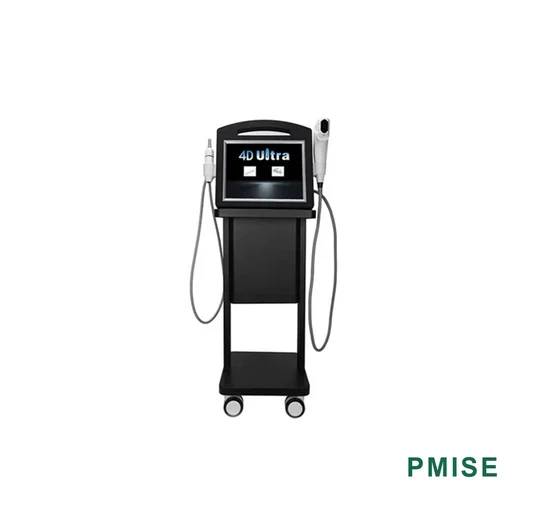 The machine that fitsPmise HF-01
4D HIFU Lifting & Tightening Platform Next noteSelective Photothermolysis, Explained Properly
The 1983 Anderson & Parrish principle every aesthetic laser and IPL relies on: chromophores, thermal relaxation time, and why pulse width matters as much as wavelength. CatalogAll platforms
Twelve machines, one factory standard, full specifications.
Ready to spec your next machine?
Tell us the indication, your market and the certifications you need. Our export team replies with a configuration and quotation within 12 to 24 hours.