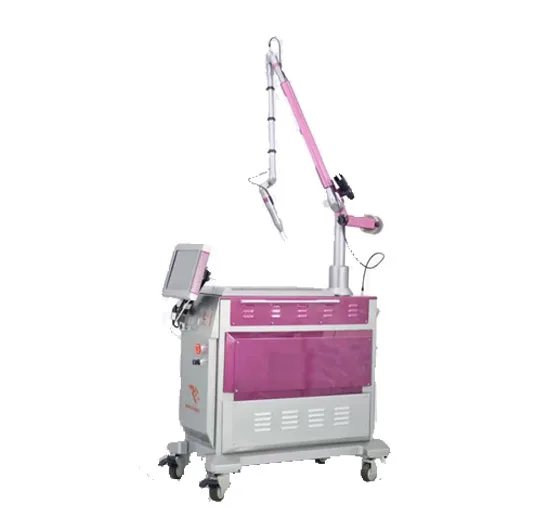
How it works
Q-switching is a shutter trick. The cavity is held below threshold while the rod soaks up pump energy, then the electro-optic switch opens and dumps the lot at once. Modest joules, enormous peak power, 6ns of it. Ink particles and melanosomes shed heat fast, so a pulse shorter than their thermal relaxation time traps energy inside the particle until it fractures. Phagocytes and the lymphatic system clear the debris over following weeks. That's selective photothermolysis, described by Anderson and Parrish in Science in 1983.
The effect is photoacoustic, not a slow cook. The particle expands faster than it can conduct heat away, and the shockwave breaks it. You see frosting, then it fades.
Two wavelengths, two jobs. 1064nm reaches deep and is absorbed weakly by epidermal melanin: black and blue-black ink, nevus of Ota, dermal melanocytosis. The 532nm line is frequency-doubled through a KTP crystal and absorbed near the surface, which suits red inks and epidermal spots. Our manuals are plain about it: 1064nm for blue, black and green-blue, 532nm for red, both for coffee and brown.
Spot size isn't only a speed control. At the same energy density a wider spot reaches deeper, so our manuals keep dermal work above 2mm and reserve sub-2mm spots for junctional nevi and scars. Hold the tip perpendicular, overlap by a third, keep the field dry. Surface water steals energy.