[email protected]  ·  +86 133 2121 6666 FDA / CE / RoHS / SGS certified
Pmise MF-05 Multifunction E-Light Platform
IPL + RF Platform

Pmise MF-05

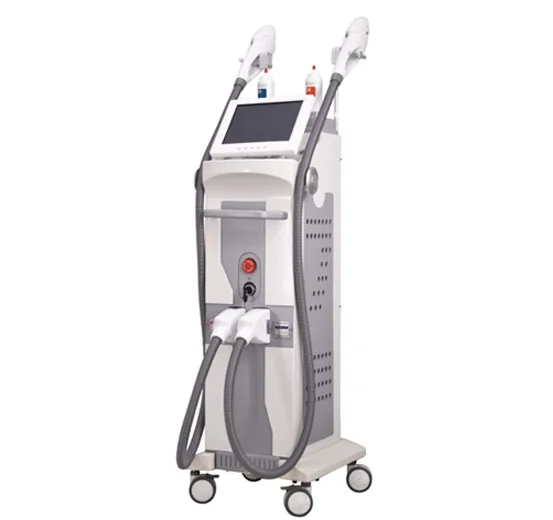
One IPL handpiece with three filters plus the cooling RF handpiece and all five tips, in a 25.5kg console. Only the pigment and acne filters cost extra.

MF-05 is the versatility play. An E-light console pairing intense pulsed light with radiofrequency, so hair, photorejuvenation and vascular work run from one 25.5kg box. First-time clinic owners buy it. So do distributors.

The standard build, stated once. One IPL handpiece with three filters: HR 610-1200nm hair, SR 530-1200nm rejuvenation, VR 585-1200nm vessels. With it, the RW-V cooling RF handpiece and all five tips, three monopolar (45, 25, 15mm) for body work, two bipolar (45, 25mm) for face and neck. Priced separately: the PR 560nm and AR 430nm filters, plus the wide 60x15mm IPL handpiece. That's the whole options list. Our note on choosing between IPL and a single-wavelength laser shows where breadth wins.

Be clear about what you're buying. Breadth, not depth. If your clinic lives or dies on one service, a dedicated platform beats this box.

How it works

The flashlamp emits broadband light. Filters pass only the band an indication needs: 610-1200nm for follicle melanin, 530-1200nm for rejuvenation, 585-1200nm for vessels, where oxyhaemoglobin absorbs. Dual filtration blocks everything under 400nm, so no UV reaches skin. Pulses run 0.1 to 10.0ms and split into sub-pulses, delays out to 20ms, keeping the epidermis off the boil. That's selective photothermolysis, Anderson and Parrish, 1983.

RF works differently. Current flows between the electrodes at 2.64MHz, up to 120W, for 0.1 to 3.0s. Heating tracks current, contact area and impedance: our figures put skin near 289 ohms, fat 2180. The archive's dermal band is 45 to 60°C, where collagen remodels. Contact decides everything: 2mm of gel, never reused, the tip always moving, two test shots after any parameter change. A parked tip burns people.

What does the RF add when melanin contrast is thin? Not a second target. Current follows impedance, not colour, so it warms the dermis of a Fitzpatrick type IV. Warm tissue needs less light for the same endpoint, and our pigment tables read that way: 40-48J/cm² at type I, 35-44J/cm² at type III, the RF setting barely moving. StatPearls reports adverse events climbing with fluence and skin darkness. Sadick's 2005 paper called that trade selective radiophotothermolysis. RF can't invent contrast: blonde, grey and red hair barely absorb, and our archive is blunt that IPL isn't effective there.

Where does a single-wavelength laser win? Coarse hair at volume, where an 808nm diode outruns a filtered flashlamp; that's our DL-07 diode platform. Very dark skin, where weak melanin absorption at 1064nm is the point. Tattoo ink needs nanosecond pulses no flashlamp makes: QE-01 territory.

Applications

  • Hair reduction on dark terminal hair, standard HR 610-1200nm filter, spaced across anagen cycles
  • Photorejuvenation for tone, texture and fine lines, standard SR 530-1200nm filter
  • Facial vessels and diffuse redness, standard VR 585-1200nm filter, a short weekly series
  • Benign pigment or inflammatory acne, each needing an extra-cost filter (PR 560nm, AR 430nm) and clinician screening
  • Bipolar RF tightening on face and neck, monopolar RF contouring on abdomen and thighs: all five tips arrive on the standard RF handpiece

Key advantages

  • Three filters standard (HR 610-1200nm, SR 530-1200nm, VR 585-1200nm), swapped in seconds; PR 560nm and AR 430nm the only filter extras
  • RF handpiece and all five tips ship in the base build: face and body RF, no second order
  • RF assist pulls optical energy down where contrast is poor: our pigment tables run 40-48J/cm² at type I, 35-44 at type III
  • Triple cooling (water, air, semiconductor) holds the tip at -2 to 0°C
  • 25.5kg on 220V or 110V: ordinary freight, ordinary socket

Specification

Handpiece TypeF+E, F+E+, RW-V (optional)
Filter WavelengthHR 610-1200nm; SR 530-1200nm; VR 585-1200nm; PR 560-1200nm (opt.); AR 430-1200nm (opt.)
Energy Density≤50J/cm²
Pulse Width0.1-10.0ms
Sub-pulse Interval0.1-20ms
CoolingWater, air and semiconductor, -2 to 0°C
Spot Size60x15mm (F+E+); 8x40mm (F+E)
RF Frequency2.64MHz
RF Power120W max
RF Duration0.1-3.0s
Input Power760W
Power SupplyAC 220V 50Hz; AC 110V 60Hz
Net Weight25.5kg
RW-V Tips (optional)3 monopolar (45/25/15mm); 2 bipolar (45/25mm)

Frequently asked questions

Which skin types can I treat, and where should I stop?

Fitzpatrick I to III is straightforward. IV and V want conservative settings, longer filters and a test spot first. Tanned skin reads as a darker type for weeks. Our manuals list pregnancy, recent sunburn, seizure history, active infection and isotretinoin within six months among contraindications. Lesions need a clinician's diagnosis.

How do I plan a course of treatment?

Hair reduction follows the anagen phase: face sessions roughly six to eight weeks apart, body sessions ten to twelve. Vascular work runs the opposite rhythm, a short weekly series. Nobody clears in one visit, so don't sell it that way. Book courses, photograph endpoints.

What should I budget for consumables, and how do I resupply?

The xenon flashlamp is the main wear part, rated in shots, so plan replacement by the shot counter, not the calendar. Gel goes steadily, never reused. The RF handpiece and its five tips come with the machine, so resupply is lamps, gel and the odd tip. PR and AR filters are a separate purchase.

What training, warranty and support come with it, and what's my next step?

Operators need filter selection, Fitzpatrick assessment, test spots, endpoint reading, sub-pulse settings and the RF movement path. Training is remote and included. Every unit carries a one-year warranty with factory spare parts, then maintenance for the life of the machine. Local rules decide who may operate. Ask for a configuration sheet on the contact page.

What can this machine not do?

Quite a lot. No tattoo removal, needing nanosecond Q-switched pulses. No ablative resurfacing, a CO2 job. It won't clear white, blonde or grey hair, and it doesn't replace a 1064nm platform on the darkest skin. Pigment and acne work waits on the PR and AR filters.

Evidence and further reading

Educational material for equipment buyers and operators. It is not medical advice, an operating protocol or a promise of clinical outcome.

Ready to spec your next machine?

Tell us the indication, your market and the certifications you need. Our export team replies with a configuration and quotation within 12 to 24 hours.