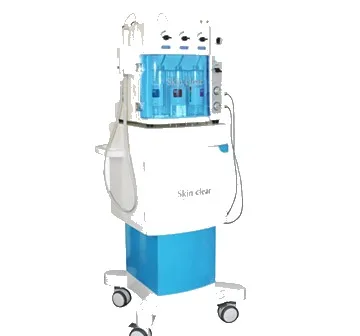
How it works
Think shear, not ablation. At the 0.3 to 0.6MPa our device manuals specify, the jet lifts loosely bound corneocytes off the top of the stratum corneum and flushes sebum from follicular openings. No thermal column, no wound. Our manuals describe blackheads blown clear, a mild passing redness, pinpoint bleeding over acne.
Depth is the operator's hand, and it's cruder than most brochures admit. Hold 0.3 to 0.5cm off the skin for peeling. Back off to 0.5 to 1.0cm with three to five gentle passes for rejuvenation. Pencil grip, 45 to 90 degrees, worked diagonally so coverage stays even. Our manuals fix the order too: forehead, cheeks, chin, cheeks again, nose, periorbital last. Those zone passes fill the 20 minutes. Thin or reactive skin gets a longer standoff and lower pressure.
Does the solution actually go anywhere? Careful there. The stratum corneum is the rate-limiting barrier for anything topical, as Menon, Cleary and Lane set out in their 2012 review, and this jet works on its outermost layers. Expect a briefly more receptive surface, not injection. Golan and Hai, in Annals of Plastic Surgery in 2005, called a supersonic oxygen-and-saline jet in 50 patients safe and effective for the usual peeling indications. That's the honest ceiling.
Compressor and tank sit outside the main unit, so work continues on compressed air once the oxygen empties. Oxygen means fire discipline: hose connected before the tank valve opens, no flame in the room. The same precautions section requires a protective eye patch during facial work, handpiece kept away from the eyes. Then the hygiene ritual. Purge the liquid, rinse with medical distilled water, cap the nozzle. None of it is optional; Kaptanoglu and colleagues reported facial and periorbital cellulitis in 2014 after jet-stream peeling by an unauthorised operator. Clinics book it days before the MF-05 multifunction E-Light platform.