Radio Frequency Skin Devices: Monopolar, Bipolar and What Changes
A radio frequency skin device heats tissue by electrical resistance, not by light absorption. That makes it largely colour-blind and a safer bet on darker skin than many laser platforms. Here's what to check before you buy one for your clinic.
How RF actually works in skin
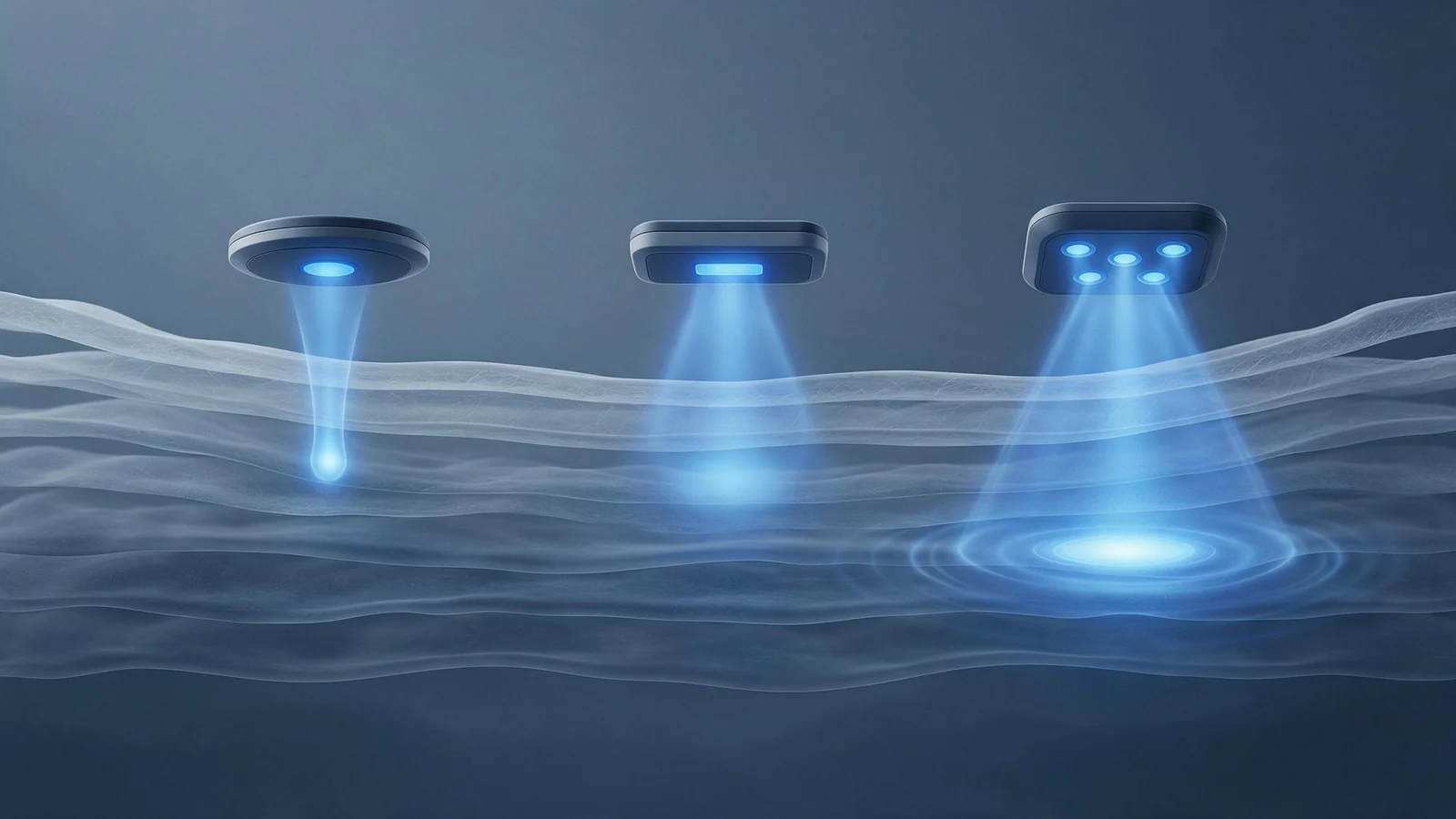
Radiofrequency current passes through tissue. The tissue resists. Resistance creates heat. That's the whole trick. RF doesn't care about melanin or haemoglobin because it isn't targeting a chromophore. Light-based devices need a target. RF just needs water and conductive tissue. So a machine radio frequency platform can treat skin types that a laser might struggle with, particularly Fitzpatrick IV to VI.
The current oscillates at high frequency, typically 0.3 to 10 MHz in aesthetic devices. As it flows, ions and polar molecules jostle. That jostling generates heat. The target is the dermis, where collagen fibres denature and contract at the right temperature. Research indicates collagen remodelling occurs between 42°C and 65°C, and lipolysis and sculpting between 65°C and 70°C, with nerve damage risk at temperatures around 85°C. That's the thermal window you are working inside. Too cool, nothing changes. Too hot, you burn fat, nerves, or worse.
Surface cooling matters because the epidermis sits above that target. If the surface gets too hot first, the client feels pain and the dermis never reaches the useful range. Good RF platforms use contact cooling, cryogen spray, or thermal feedback to keep the skin surface below about 40°C while the dermis climbs higher. Our engineering archive notes that the archive's own RF device, the RF-01, is built with a monopolar and bipolar handpiece combination. The manual stresses real-time epidermal temperature monitoring as the primary safety interlock.
Monopolar: the deep-heat workhorse
Monopolar RF has one active electrode on the skin and a return pad somewhere else, usually the back or thigh. Current flows from the handpiece through the body to that pad. The main advantage of monopolar delivery is the concentration of a high-power density on the surface of the electrode and the relatively deep penetration of the emitted power. Because the return electrode is far away, the field spreads wide. Energy reaches deeper structures: fat, fibrous septae, and the deep dermis.
That depth is why monopolar devices get used for body contouring and thicker skin. But depth without control is a liability. The current takes the path of least resistance, which may not be where you want it. You need good coupling gel, steady hand speed, and a patient who can tolerate the heat. A porcine model study on monopolar RF recorded peak temperatures of 50°C, 60°C, and 70°C in the dermis with no thermal damage, but the device used real-time temperature feedback. Without feedback, monopolar can be unpredictable.
Most modern monopolar handpieces have built-in thermistors or infrared sensors. When the dermis hits the target, the device reduces power or tells you to move. That feedback loop is the real safety feature, not the max wattage on the brochure. If you are comparing devices, ask how fast the feedback loop samples temperature and whether it controls power automatically or just alarms.
Bipolar and multipolar: shallower, tighter, more controllable
In a bipolar configuration, the current flows between two identical electrodes that are set at small fixed distance apart; no grounding pad is necessary. Both electrodes sit in the same handpiece. The field is concentrated between them. In bipolar systems where the electrodes are placed flush on the skin, the depth of penetration is limited to approximately half the distance between the electrodes. If your electrodes are 4 mm apart, you treat about 2 mm deep. That's still within the dermis on most facial areas.
Bipolar RF is more predictable. You know roughly where the energy goes. You don't get the deep fat heating of monopolar, but you get safer, more repeatable treatments. For fine lines, periorbital skin, and neck tightening, that's often enough. Many devices now combine multiple electrode pairs in one tip, calling it multipolar. The penetration depth of multipolar RF when delivered on the skin surface averages about one-half the distance between the electrodes. The marketing makes it sound like energy criss-crosses in three dimensions. In reality, multipolar is just several bipolar pairs firing in sequence or simultaneously. It covers a larger surface area per pulse. That's the practical benefit: faster full-face coverage.
Some handpieces claim "tripolar" or "quadrupolar" configurations. The clinical difference is modest. What matters is electrode spacing and power density. Ask the manufacturer for a diagram of the electric field. If they can't produce one, that tells you something.
Temperature control is the actual safety feature
Every RF platform gets hot. The question is how hot, and whether the device knows it. Older machines relied on operator experience: you watched for erythema, asked the client about pain, and hoped. Newer devices embed sensors in the handpiece tip. The first microneedle RF device is based on thermistors within electrode needle tips, allowing real-time feedback of both impedance and temperature. That was for needles. For non-invasive surface RF, infrared thermometers or contact thermocouples do the same job.
Why does this matter for a buyer? Because a device that controls temperature automatically can be used by less experienced staff. The machine adjusts power every few milliseconds. It reduces the risk of burns, fat atrophy, and post-inflammatory hyperpigmentation. On darker skin, that risk is higher. Any RF treatment that overheats the epidermis can trigger PIH. Cooling and feedback are not optional extras on skin types IV to VI.
Ask about the control algorithm. Does it maintain a set temperature, or does it just cut off at a threshold? A good device keeps the dermis in the 42°C to 65°C window for several seconds. That's where collagen denatures and remodels. If the device doesn't hold temperature, you get either no effect or a burn.
What the treatment feels like, and session structure
Most clients describe surface RF as a warm massage with occasional hot spots. Monopolar on the body can feel like a deep heat that builds. If you're treating the face, a typical session lasts 20 to 40 minutes. The operator moves the handpiece in slow circles, keeping contact with the skin. Some protocols call for a single pass; others build heat over multiple passes. There is no downtime. The skin may be pink for an hour.
A salon running back-to-back sessions on a Saturday needs a device that doesn't fight the operator. Heavy handpieces cause fatigue. Poorly designed cooling makes the client flinch. If the machine requires constant recalibration, your throughput drops. Ask to hold the handpiece. Run it on your own forearm. If the operator interface makes you think, imagine using it for six hours straight.
Session packages typically involve 4 to 6 treatments spaced 2 to 4 weeks apart. Maintenance every 3 to 6 months is common. That schedule keeps clients returning. It also means the device needs to be reliable enough for daily use. Check the service interval and whether the manufacturer offers loaner units during repairs.
RF next to focused ultrasound in the same room
Many clinics now run both radiofrequency and HIFU platforms. They are not competitors; they stack. RF heats a broad volume of dermis. HIFU creates tiny, precise thermal coagulation points at fixed depths, usually 1.5 mm, 3.0 mm, or 4.5 mm. RF is diffuse. HIFU is focal. A client with loose neck skin and a heavy lower face might get HIFU for the SMAS layer and RF for overall dermal tightening. The combination makes sense because the mechanisms are different.
If you already own a HIFU platform, adding a radio frequency skin device expands your menu without cannibalising it. Clients who can't tolerate HIFU's sharp, deep pulses may prefer RF's diffuse warmth. Conversely, a client with good skin elasticity but localised jowls may get more from HIFU. The two technologies complement each other in a well-run aesthetic practice.
For a deeper dive, see the full RF and HIFU technology comparison in our technology library. It covers tissue interaction, penetration depth, and treatment endpoints in more detail.
What to check before you buy
- Frequency range: 0.3 to 10 MHz is standard. Higher frequency heats more superficially; lower goes deeper but is less comfortable.
- Electrode configuration: monopolar for depth, bipolar for control, multipolar for speed. Many devices offer all three in one platform.
- Temperature feedback: real-time thermistors or IR sensors with automatic power modulation. Without this, operator error risk is high.
- Cooling method: contact cooling, cryogen, or chilled gel. Must keep epidermis below 40°C.
- Handpiece weight and ergonomics. You will hold it for hours.
- Service and warranty: what's the turnaround time? Does the manufacturer offer a loaner?
- Clinical training: does the supplier provide protocols for different skin types and body areas?
FAQ
Is radiofrequency safe for darker skin types?
Yes, largely. Because RF heats by electrical resistance rather than melanin absorption, it does not target pigment. The main risk on darker skin is post-inflammatory hyperpigmentation from overheating the epidermis. That risk is managed with surface cooling and temperature feedback. Always test patch on skin types V and VI, and avoid aggressive settings near the eyes.
How deep does RF penetrate?
It depends on electrode configuration. Monopolar RF can reach several millimetres, including fat. Bipolar and multipolar systems penetrate roughly half the distance between electrodes. If electrodes are 4 mm apart, expect about 2 mm depth. Microneedle RF bypasses the epidermis entirely and delivers energy at precise depths, typically 0.5 mm to 3.5 mm depending on the needle length and treatment area.
How many treatments does a client need?
Most protocols call for 4 to 6 sessions spaced 2 to 4 weeks apart. Maintenance every 3 to 6 months is common. Results build gradually as collagen remodels over 8 to 12 weeks after the series. Some clients see subtle tightening after one session, but the full effect takes time.
What's the difference between RF and laser?
Lasers target chromophores like melanin or haemoglobin. RF heats tissue by electrical resistance, so it is largely colour-blind. This makes RF more versatile across skin types but less precise for pigment-specific lesions. Lasers can ablate or coagulate with high spatial control; RF provides diffuse volumetric heating. Many clinics use both.
This page is educational material for equipment buyers, not medical advice. Diagnosis and treatment decisions require a qualified practitioner.
Evidence and further reading
Educational material for equipment buyers and operators. It is not medical advice, an operating protocol or a promise of clinical outcome.
- Cutaneous remodeling and photorejuvenation using radiofrequency devices
- Physics of fractional microneedle radiofrequency – A review
- Monopolar radiofrequency for dermal temperature regulation and remodeling: A porcine model study
- Radiofrequency Microneedling: Technology, Devices, and Indications in the Modern Plastic Surgery Practice
Keep reading
Ready to spec your next machine?
Tell us the indication, your market and the certifications you need. Our export team replies with a configuration and quotation within 12 to 24 hours.