Professional Microneedling Pen: Buyer's Guide for Clinics
A professional microneedling pen is a motorised instrument that drives sterile needle cartridges into the skin at a set depth, and it is the format most clinics reach for first because it is simple, fast and easy to train on. But the pen is only one of three commercial formats you can buy, and the one you should buy depends on what your licence actually allows you to do. This guide walks clinic owners and distributors through format selection, motor and depth specs, cartridge economics, and the certification paperwork you should demand from any supplier before money changes hands.
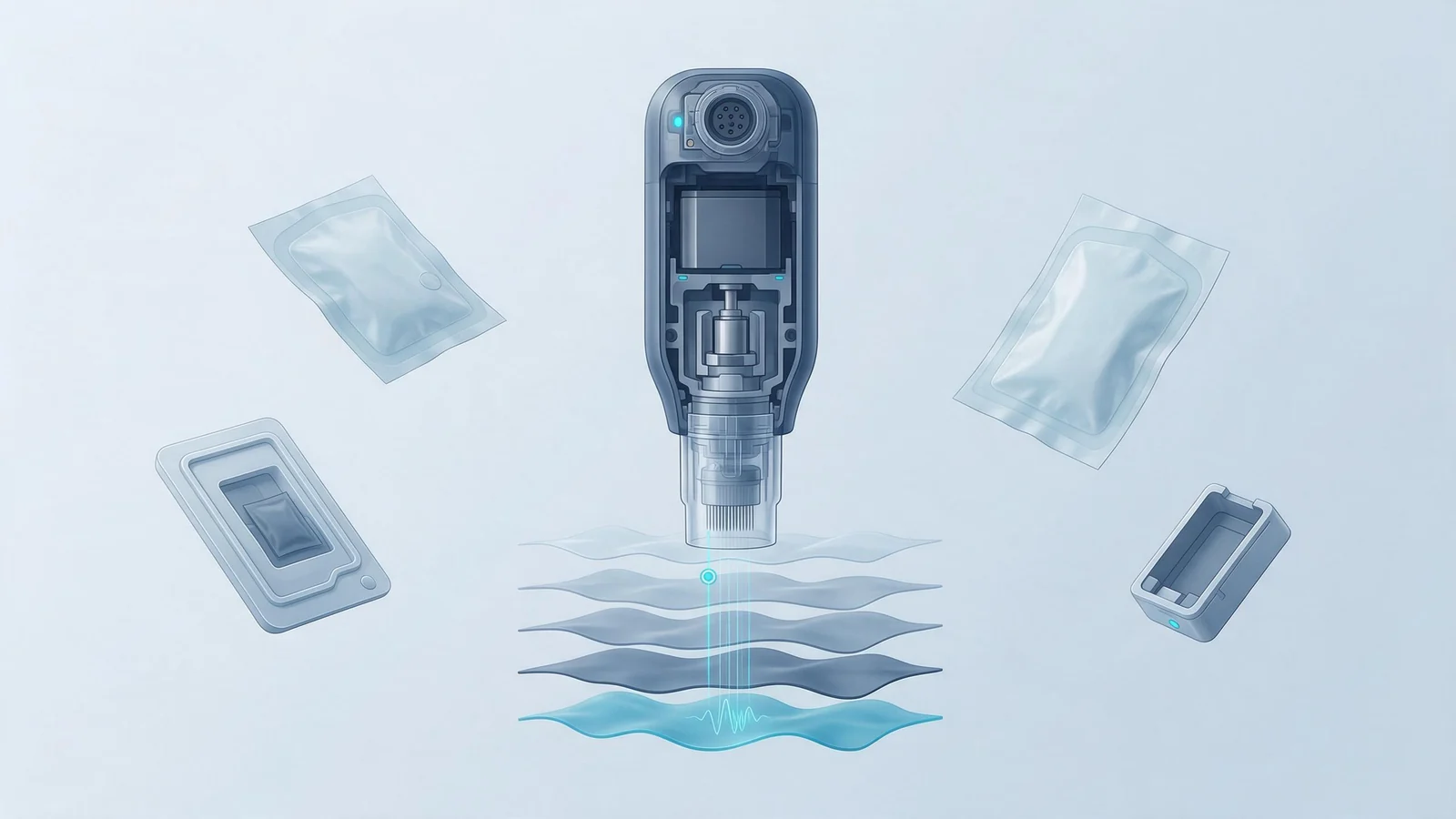
What Makes a Microneedling Pen 'Professional' vs a Home Device
A microneedling device is an instrument with multiple small needles, tips or pins that puncture the skin. That same definition covers a ten-dollar roller from a pharmacy and a clinic console, which is exactly why the market is so muddy. Our engineering archive splits the category into three commercial formats. Manual rollers and stamps, motorised pens, and RF microneedling consoles are the three commercial formats our engineering archive identifies. A roller is dragged. A stamp is pressed, and a pen is driven by a motor at a controlled speed. That motor is the whole point. Here's the practical divide.
A home device is built to be safe in untrained hands, so it's shallow, slow and disposable. A professional pen is built to be consistent in trained hands: stable motor speed, an adjustable depth scale you can read and reset, and a cartridge interface that only accepts sterile, single-use tips. If a supplier can't tell you the depth range in millimetres and the needle count per cartridge, you're not looking at a clinical instrument. One more thing worth saying plainly. Professional platforms are sold per configuration to clinics and distributors. They aren't consumer gadgets with a checkout button, and they shouldn't be priced like one.
Microneedling Pen vs RF Microneedling: Which Platform Fits Your Clinic
This decision trips up more buyers.
Two platforms work on completely different physics, and a pen performs mechanical puncture for collagen induction: needles enter the skin, withdraw, and your body handles the rest through controlled wound healing, while a radiofrequency microneedling console does something else entirely.
Insulated needles penetrate deep.
They release RF currents from the needle tips, combining mechanical injury with thermal energy delivered at a chosen depth.
The published review describes it as microneedling plus targeted delivery of RF energy to deeper layers of the skin, stimulating collagen and elastin production through controlled dermal injury (Effectiveness of Radiofrequency Microneedling in the Treatment of Dermatological Conditions).
Each family acts.
On tissue at a different depth, which matters for protocols and for comfort, and published depth guidance for RF microneedling targets the reticular dermis, with recommended depths of at least 1.5 mm for the forehead and temporal skin, 1.0 mm for the malar region, 2.0 mm for the nasal side walls, 0.5 mm for the perioral skin, and 1.5 mm for the neck.
A mechanical pen has no thermal component, so depth selection follows a different logic.
Now the licensing question, which nobody on page one addresses, and salon versus clinic ownership determines which energy family a beauty therapist can legally operate without a medical director.
In most markets a mechanical pen sits on the lighter side of that line and an RF console sits on the heavier side, but the line itself is set locally, not by the manufacturer.
Check your own scope of practice before you sign anything.
If you're weighing the two families, our comparison of HIFU and RF microneedling covers how the deeper energy platforms sit relative to each other.
Only one of these is a medical platform sold per configuration.
The pen can be either, depending on who built it and how it's registered.
The console almost always is.
Motor, Speed and Needle Depth: The Specs That Decide Treatment Consistency
Buyers count speeds. Five, seven, nine: that number tells you almost nothing about whether the motor holds its set speed under load, and a motor that sags when the needle meets resistance gives you an inconsistent stroke and an inconsistent treatment.
Depth accuracy is the other half of that problem. Insertion depths run 0.3 to 2 mm, set or adjustable by manufacturer, and the published literature splits cosmetic microneedling, up to 0.5 mm on the face, from medical needling, up to 2 mm, which reaches the dermis layer. Two ranges, two consent conversations, two aftercare protocols, and in many jurisdictions two different operators.
Why does it matter? Because the needle has a job to do. Microneedles must pierce the stratum corneum, roughly 10 to 20 micrometres thick, without bending or rupturing on the way in. Bend one and you've got a comfort problem and a consistency problem at once.
Want a fully specified platform? Look at the Pmise MN-01 gold RF microneedling system in our own range. Needle depth is 0.5-3.0mm adjustable, with 1-10 energy levels, RF working time of 50-950ms, RF output power of 50W, output frequency 2-4MHz, output power 10-200W, negative pressure 0-2 level, an 8.4 inch TFT touch LCD screen, RF frequency 2Hz, and a delay interval of 0-3s. Treatment handles include Microneedle, Acne Handle and Cold Hammer. Expect that level of detail from any supplier, pen or console. The full listing sits on the MN-01 RF microneedling platform page.
For a wider view, the RF microneedling machines buyer guide walks through how depth, speed and cartridge systems compare across formats, platform by platform.
Sterile Cartridge Economics: Cost Per Treatment, Not Device Price
Here's where clinic owners get burned. The pen itself is cheap, but the cartridges are where the real money goes, so don't let anyone tell you otherwise.
A cartridge is a consumable. You're not buying it once and you're done, so the number that belongs in your spreadsheet is cost per patient, not device sticker price. Divide your cartridge cost by the number of patients you treat per month and compare that to your per-session pricing. If the cartridge eats too much of the session fee, the platform is wrong for your volume, no matter how good the motor is.
Single-use sterile cartridges are also a liability question, not just a cost question. Reusing a cartridge breaks sterility, and it can void your professional indemnity cover if your insurer's terms require single-use consumables. That's a conversation to have with your broker before you buy, not after an incident.
What should you ask a supplier about cartridges?
- Are the cartridges single-use and sterile, and is that stated in writing on the packaging spec?
- How many needles per cartridge, and are different needle counts available for different protocols?
- Is the cartridge interface proprietary, and how long is the reorder lead time to your country?
- What is the minimum order quantity for consumables, and does it change by needle count?
Ask for the needle count in writing. A vague answer here usually means the supplier hasn't locked their own bill of materials, which is a bad sign for your reorder pipeline six months from now.
Certification and Regulation: What to Verify Before You Buy
No certification, clearance or registration. Nothing in our recorded facts lists one for any Pmise model, so we won't claim one, and what we can do instead is tell you exactly what to demand from any supplier, including us. Microneedling has a real regulatory framework. The FDA issued a guidance document titled Regulatory Considerations for Microneedling Products on November 10, 2020, following a draft issued on September 15, 2017, under docket number FDA-2017-D-4792. That document covers definitions. It spells out which microneedling products are devices, which aren't, and how certain microneedling devices get classified.
Classification matters because it's model-specific, and you can see that in the actual clearances. The FDA cleared the Exceed Microneedling device under K182407, regulated as a Microneedling Device For Aesthetic Use under 21 CFR 878.4430, Class II, Product Code QAI. It cleared the SkinPen Precision Elite System under K241400 on August 29, 2024, in the same category. Two clearances, two model numbers, two submission files. There's no such thing as a generic Class II clearance for a category of pens.
So when a supplier tells you their pen is FDA cleared, ask for the K number and the model it covers, then verify it yourself.
- Certificate scope: which product families and models does it actually cover?
- Model numbers: does the certificate match the unit you'll receive, exactly?
- Issuing body: who signed it, and are they accredited for this scope?
- Expiry: is it current, and what's the renewal date?
- Database entry: ask for the regulator's own registration database record, not a PDF logo on a brochure.
Any supplier with a genuine registration will send you the database link within a day. Anyone who sends a JPEG is telling you something.
Matching the Device to Your Business: Salon, Clinic or Distributor
Three buyer types.
If you run a salon, your first question is legal, not technical, because salon versus clinic ownership determines which device a beauty therapist can legally operate without a medical director. Get that answer in writing from your local regulator before you shop.
A pen that's legal for your staff is worth more than a console that isn't.
If you run a clinic, you have more headroom. Depth range, handpiece options and the ability to run multiple protocols on one platform matter more than the lowest unit price, so look at the consumable math from the previous section and project it across your monthly patient volume.
If you're a distributor, unit price is the wrong first question.
Aesthetic equipment manufacturers typically offer OEM and ODM services plus training, technology support and maintenance, and those terms are what your resale business actually runs on. Ask about territory, spare parts availability, engineer training and response time. A cheap unit with no parts pipeline is a support burden you'll own for years.
For context on where we sit: Pmise is a Beijing-based manufacturer of laser, light and energy-based aesthetic equipment that sells professional platforms to clinics and distributors.
We quote per configuration. That's the model for this category.
Buyer Checklist: Questions to Ask Any Microneedling Pen Supplier
Print this. Take it to every meeting, and ask these questions before you sign anything.
| Area | Question | What a good answer looks like |
|---|---|---|
| Certification | Which models does the certificate cover, who issued it, and when does it expire? | A model-specific document plus a regulator database reference |
| Cartridges | Are they single-use and sterile? Needle count? Compatibility? Reorder lead time? | Written spec sheet with needle counts and lead times by country |
| Motor and depth | Send the spec sheet: speed, depth range, needle count per cartridge | A document that matches the shipped unit, not a marketing page |
| Training and support | Training, spare parts and after-sales terms in writing | A contract clause, not a verbal promise |
| Consumable economics | Cost per treatment at my patient volume | A worked number, not a per-unit price |
Two last points. If you're comparing this format against deeper energy platforms, our microneedling machines guide covers the wider category. And if you're treating patients with darker skin types or a history of post-inflammatory hyperpigmentation, build a test-spot protocol and get a clinical opinion before you scale a treatment plan. This is educational material for equipment buyers, not medical advice.
FAQ
Which microneedling pen is best for professional use?
No single pen wins for everyone. What suits you comes down to your licence, your protocols and the volume you handle. Check four things. Does the motor hold speed under load, is depth adjustable and accurately marked? Is the cartridge system single-use and sterile, and can the supplier produce a model-specific certification document with a regulator database reference? A pen that wins on all four beats a famous brand name that only wins on the first.
What microneedling pens do salons use?
Most salons run motorised pens. Not RF microneedling consoles, which demand more oversight than a standard treatment room usually has. Pens sit lighter on the regulatory scale. They're easier for beauty therapists to operate without a medical director, though the legal line shifts depending on where you are. It differs by country. Sometimes by state or province too. Ask your local regulator which depth range and device type your staff may legally operate. Get that answer in writing before you buy.
Can an esthetician buy a SkinPen?
You might wonder if you can buy a cleared device as an esthetician. Local scope-of-practice rules and the manufacturer's distribution terms answer that question, not the device category. Some cleared platforms are physician-supervised only. That means your ability to purchase one depends on where you work and what the maker allows. Ask the manufacturer or its local distributor for their eligibility requirements in writing, and check with your own licensing board first. Don't assume you can buy and use one.
How much is a professional micro needling pen?
We don't publish prices. Any figure quoted without a configuration should make you suspicious, because professional platforms get quoted per configuration. That means the handpiece, cartridge types, needle counts and support terms all move the number. Cost per patient is what matters. Divide your cartridge cost by monthly patient volume, then compare that against your session fee. That number tells you whether the platform is profitable for your clinic.
Evidence and further reading
Educational material for equipment buyers and operators. It is not medical advice, an operating protocol or a promise of clinical outcome.
- Regulatory Considerations for Microneedling Products
- Effectiveness of Radiofrequency Microneedling in the Treatment of Dermatological Conditions: A Systematic Review
- Radiofrequency Microneedling: Technology, Devices, and Indications in the Modern Plastic Surgery Practice
- Mechanically Induced Skin Renewal: Evidence-Based Insights Into Clinical, Structural and Inflammatory Changes Activated by Microneedling, Microdermabrasion and Microvibration
- Engineering Microneedle Patches for Improved Penetration
Keep reading
Ready to spec your next machine?
Tell us the indication, your market and the certifications you need. Our export team replies with a configuration and quotation within 12 to 24 hours.