Inside a HIFU Transducer: What You Are Really Buying per Cartridge
A HIFU transducer is the part of the machine that actually shapes the ultrasound into a hot, focused point under the skin. Buyers who understand the cartridge understand the whole device. What looks like a disposable accessory is actually the entire treatment engine.
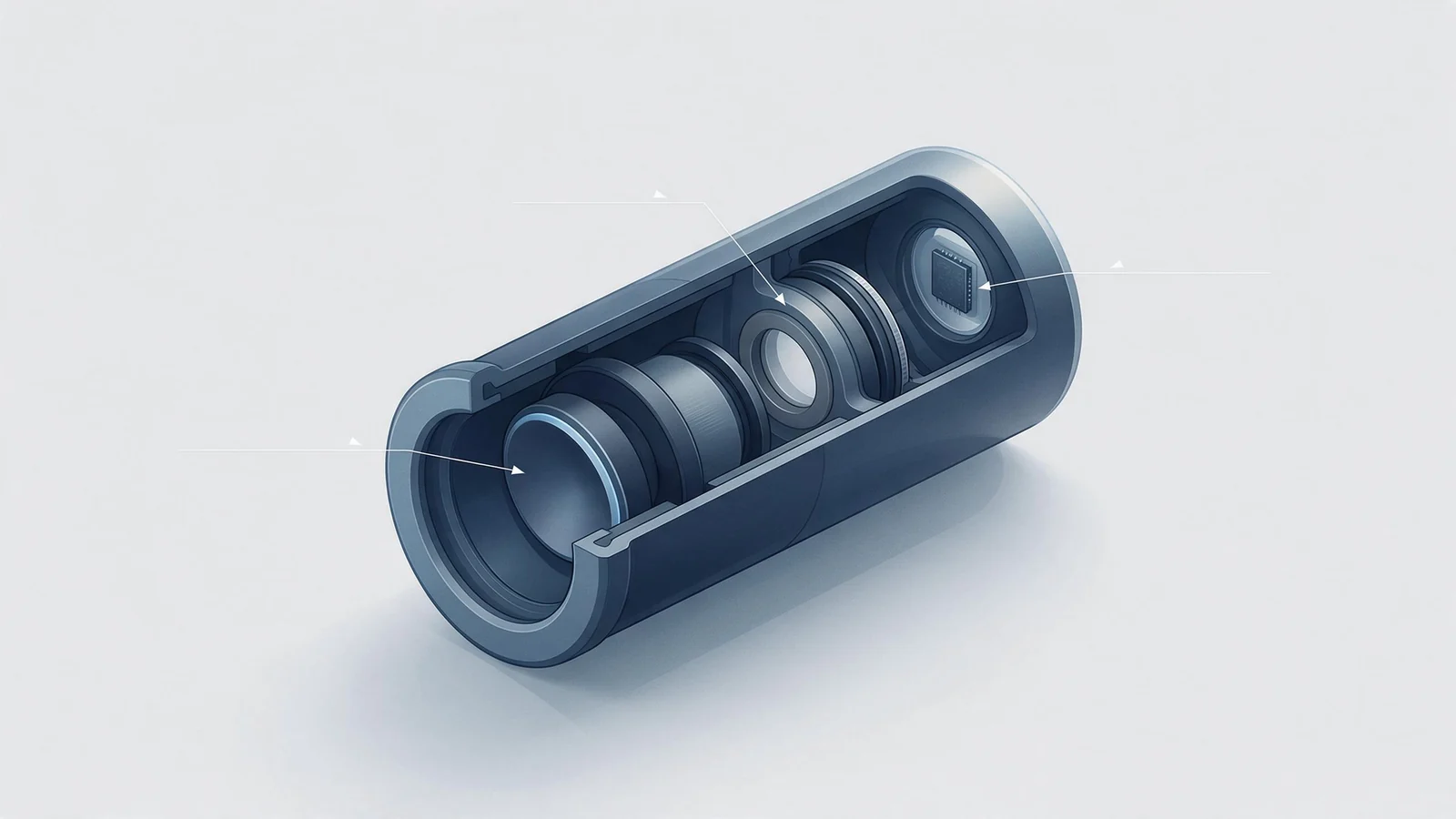
The cartridge is the engine
Open a HIFU handpiece and you'll find a motor, some wiring, and a socket. The part that makes the treatment work is the cartridge: a sealed assembly holding a piezoelectric transducer, an acoustic lens or curved crystal, and usually a shot counter chip. Swap the cartridge and you've changed the focal depth. That's not a software setting.
Our engineering archive describes the transducer as a spherically curved, bowl-shaped source. In one research setup, the aperture was 64.0 mm with a central opening of 42.0 mm, focal length 45.0 mm, running at 1.5 MHz. Aesthetic devices are smaller, but the principle holds. The curve of the crystal determines where the ultrasound converges. Flatter curve, deeper focus. Tighter curve, shallower. You cannot change that with a touchscreen.
Why do clinics own four cartridges? Because depth is mechanical, not digital.
That's the first thing to internalise. If a salesperson tells you the device has 'adjustable depth' on one cartridge, ask whether it swaps transducers internally or just relabels the same output. The answer tells you how honest they are.
Focal depth is built, not dialled
Ultrasound focuses the way a magnifying glass focuses sunlight. The lens has one focal length. The transducer's curvature, material, and frequency fix the point where energy concentrates. Change the frequency and you change absorption, penetration, and the size of the focal zone. But the depth you treat at is decided when the cartridge is manufactured.
Treating skin at 1.5 mm, 3.0 mm, or 4.5 mm means three different transducer geometries. Some systems offer dual-depth cartridges with two elements stacked or side by side. That's still hardware. A single element cannot shift its focal point on the fly. If the screen shows 4.5 mm but the cartridge says 3.0 mm, the screen is lying. IEC 60601-2-62 explicitly prohibits display of incorrect numerical values associated with the therapy.
So a clinic doing full-face lifting and periorbital work needs at least two cartridges. A body treatment room needs a deeper one. Many buyers budget for the console and forget this. Then they run a Saturday clinic with one cartridge, treating every patient at the same depth, wondering why results are mediocre. Cartridge economics covers the money side. Here the point is simpler: depth equals hardware.
Piezoelectric: the crystal that pushes
Piezoelectric material converts electrical pulses into mechanical vibration. Apply voltage, the crystal deforms. Reverse the voltage, it deforms the other way. Switch fast enough, tens of thousands of times a second, and the surface pushes air or tissue. In HIFU, frequencies around 1-4 MHz are typical for deep heating, though aesthetic systems often run higher for tighter focal zones.
The transducer can be a single large element or an array of small ones. Phased arrays can steer the focus electronically, which is how MR-guided systems like Sonalleve work. That system integrates a high intensity phased array focused ultrasound transducer with an MRI scanner for real-time targeting. But most aesthetic HIFU devices use fixed-focus single elements. Cheaper to make, easier to cool, and the focal point stays put.
Efficiency matters. A transducer that converts electrical energy to acoustic energy poorly wastes power as heat in the handpiece. That heat can crack the housing or degrade the crystal. The shot counter chip often includes temperature sensing, shutting the cartridge down if it overheats. This is a safety feature, not a money grab.
Shot count: a locked odometer
Every HIFU cartridge has a finite life. The piezoelectric crystal fatigues. The acoustic lens delaminates. The matching layer that couples ultrasound into the skin wears. Manufacturers rate cartridges for a maximum number of shots, typically 8,000 to 15,000 depending on the model. The shot counter tracks every pulse emitted, not every button press. If the device fires in bursts, each burst counts as multiple shots. If you pause mid-treatment, the counter only advances on actual output.
Why is it locked? Because after the rated shots, output may become unstable. The focal point can drift, power can drop, or the crystal can crack. A clinic that keeps using an expired cartridge is delivering unpredictable energy to a paying patient. The manufacturer's liability ends at the counter. IEC 60601-2-62 does not allow production of unwanted ultrasound output, excessive output, or unwanted thermal or mechanical tissue damage. An exhausted cartridge risks all three.
So when a reseller offers you a 'reset tool' or an 'unlocked' cartridge, walk away. That's not a saving. That's a device that will eventually fire mistimed, mis-focused pulses. You might as well treat with a blindfold on. The counter is not a subscription fee. It's a safety interlock. If a cartridge has no counter, ask why. The answer is usually 'we don't want to limit you', which sounds generous until you realise they're also not limiting the risk.
What kills a cartridge
Cartridges fail in predictable ways. Know them and you'll know what to inspect before each shift.
- Coupling loss: The gap between the transducer face and the skin must be filled with gel or a solid acoustic window. Air reflects almost all ultrasound. If the coupling layer degrades, energy reflects back into the crystal, overheating it. IEC 60601-2-62 specifically addresses reflection of excessive ultrasonic power at the transducer/patient interface due to inadequate coupling.
- Housing cracks: Repeated heating and cooling cycles stress the plastic housing. A hairline crack lets in moisture, which shorts the electronics or changes the acoustic impedance. Inspect under bright light.
- Cable strain: The cable between the console and handpiece flexes constantly. Internal wires break, usually at the strain relief. The device may still power on but deliver intermittent output. If your shots feel weak, check the cable before blaming the cartridge.
- Storage: Cartridges are sensitive to temperature extremes. Don't leave them in a cold car overnight or next to a window in summer. The crystal's resonant frequency shifts with temperature. Most manuals specify storage between 10-30°C and low humidity, similar to our laser systems.
One more thing: drops. A cartridge that falls from waist height onto a tile floor may look fine. The crystal inside can microfracture. The next thousand shots will be uneven. Mark dropped cartridges and consider retiring them early.
The third-party trap
A generic cartridge for a popular HIFU system costs half the original. It will fit. It may even fire. But it will not perform the same.
The transducer's curvature must match the console's driving waveform. The impedance must match the amplifier. The focal depth must match the label. Third-party manufacturers rarely have access to the original design files. They reverse-engineer, often badly. A cartridge labelled 4.5 mm might focus at 4.0 mm or 5.2 mm. The difference is invisible on screen but changes the treatment depth by a full skin layer. That's the difference between heating the SMAS and heating fat.
Output consistency across shots is another problem. A quality cartridge delivers within a few percent of rated power for every pulse. A cheap one may vary by 20% or more. You won't know without a hydrophone, and no clinic has a hydrophone. So you're trusting the patient's face to someone else's quality control.
Then there's the counter. Original cartridges from Pmise have a locked counter because the company stands behind the rated lifetime. A third-party cartridge with a resettable counter removes all predictability. You save $500 per cartridge and spend it on a dissatisfied patient who didn't see results. Our service team has seen clinics burned by this. Ask about cartridge availability and lead time before you buy the console. A cheap console with slow, expensive cartridges is a trap.
Buying checklist
Before signing, get answers to these five questions. Write them down.
- What is the rated shot count per cartridge? (Lower than 5,000 is a red flag for a fixed-focus aesthetic device.)
- How many focal depths are available, and does each depth require a separate cartridge?
- What is the typical lead time for replacement cartridges? (Two weeks is acceptable. Two months is not.)
- Does the cartridge have a locked shot counter that cannot be reset by the user?
- Is there a thermal sensor inside the cartridge that halts output if it overheats?
If the answers are vague, the product is vague. Walk away.
FAQ
Can I change the focal depth in the software?
No. The focal depth is determined by the physical curvature of the transducer or acoustic lens. Software can only select which transducer is active if the cartridge has multiple elements. If the console shows a depth change on a single-element cartridge, it is misreporting. IEC 60601-2-62 prohibits displaying incorrect numerical values associated with the therapy.
Why does the cartridge have a shot limit?
The piezoelectric crystal and acoustic matching layer degrade with use. After the rated number of shots, output may become unpredictable. The locked counter prevents use beyond the safe lifetime. An unlocked counter defeats this safety feature and exposes patients to unstable ultrasound output.
Are third-party cartridges really that bad?
They can be. Without access to original specifications, third-party manufacturers often get the focal depth, impedance, or power output wrong. This leads to inconsistent results and a higher risk of adverse effects. The cost saving is small compared to the cost of a poor treatment outcome.
How should I store spare cartridges?
Keep them in a cool, dry place, ideally between 10-30°C. Avoid direct sunlight and extreme temperatures. Do not drop them, and inspect the housing and cable before each use. A cracked housing or damaged cable can cause failure mid-treatment.
This page is educational material for equipment buyers, not medical advice. Always follow your local regulations and manufacturer instructions.
Evidence and further reading
Educational material for equipment buyers and operators. It is not medical advice, an operating protocol or a promise of clinical outcome.
- Overview of Therapeutic Ultrasound Applications and Safety Considerations
- IEC 60601-2-62:2013
- Three-dimensional passive acoustic mapping of high intensity focused ultrasound fields using sparse synthetic apertures from rotated one-dimensional linear arrays
- Focal High-Intensity Focused Ultrasound Ablation of the Prostate
Keep reading
Ready to spec your next machine?
Tell us the indication, your market and the certifications you need. Our export team replies with a configuration and quotation within 12 to 24 hours.